
Au revoir and thanks for the last dance, Cluster
Update, morning of 1 September 2026:
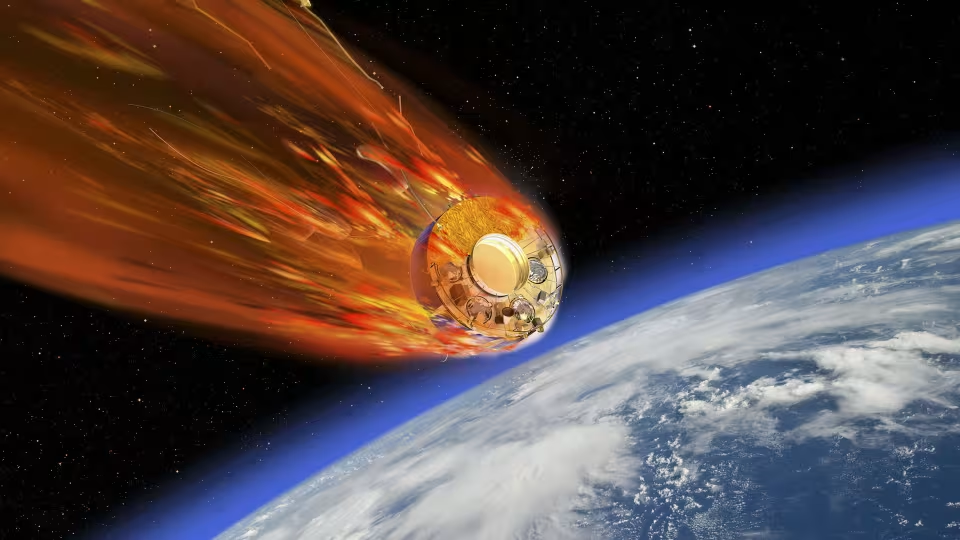
Cluster satellite 3, named Samba, re-entered at 01:39 Finnish time on 1 September. The last signal from it was received at 01:26. The observation team near Tonga in the Pacific Ocean succeeded in photographing the re-entry and the satellite’s destruction in the atmosphere.
---
One of the most important and distinctive projects in Finland’s space history is the family of four Cluster satellites. They measured the interaction between Earth and the Sun while orbiting the planet for almost 25 years. Their orbit around Earth was highly elliptical, ranging from a few hundred kilometres to 125,000 kilometres in altitude. They therefore passed through different layers of the magnetosphere and were able to study it and its phenomena in detail.
By using four identical satellites instead of one, Earth’s magnetic field and space weather could be mapped in three dimensions.
The quartet – Rumba, Salsa, Samba and Tango – was launched on two rockets in the summer of 2000. The satellites’ work ended in September 2024, when the first of them (Salsa) was steered into the atmosphere to burn up. The second satellite, Rumba, followed in October 2024.
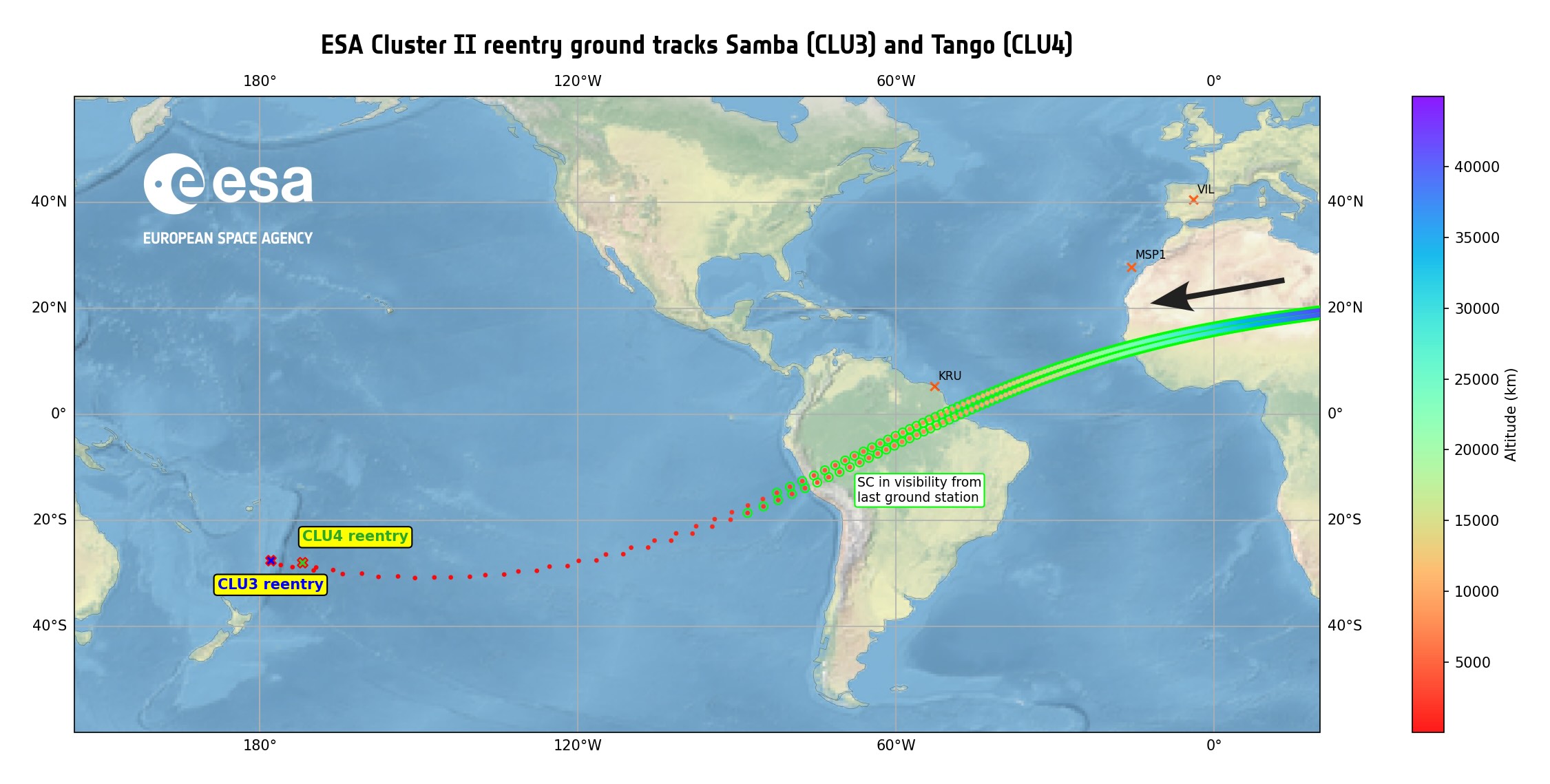
Time is now running out for the last two satellites: Samba re-enters tonight (31 August–1 September) and Tango about a day later.
Re-entry takes place in a controlled manner into a region of the Pacific Ocean with very few islands and little ship or air traffic. The satellites are almost completely destroyed already in the air, although some fragments may still fall into the sea.
The European Space Agency is following the satellites’ final moments in this blog.
The events are being watched very closely, because the re-entries make it possible to learn more about how a returning satellite breaks up in the atmosphere. The satellites remain in contact and provide telemetry. Communication continues until the last moments.
In addition, ESA has sent an aircraft to the area to attempt visual observations of the falling satellites.
Eight flight-worthy Cluster satellites were built in total, because the original four were destroyed when Ariane 5’s first flight failed. Since Cluster was an essential part of the research programme ESA had chosen some 30 years ago, it was decided to rebuild the satellites – and this time to launch them as cheaply as possible on two rockets.
The satellites contained a substantial amount of Finnish space technology. When the project began, Finland was just joining the European Space Agency, so ESA had a need to procure equipment from Finland. This was not charity: Finland already had a great deal of know-how that was important for the mission.
The University of Oulu took part in building two instruments in cooperation with international teams:
- EFW (Electric Fields and Waves), an instrument measuring electric fields and plasma waves. Essential parts of it were made in Oulu.
- RAPID, an instrument measuring energetic particles.
In addition, Finnyards and VTT supplied parts to the satellite as subcontractors to the German company Dornier (now Airbus Defence and Space), which had prime responsibility for building the satellites.
Finnish researchers used Cluster data extensively in space-weather research; it is one of the traditional strengths of Finnish space science.