
Three interesting rocket launches
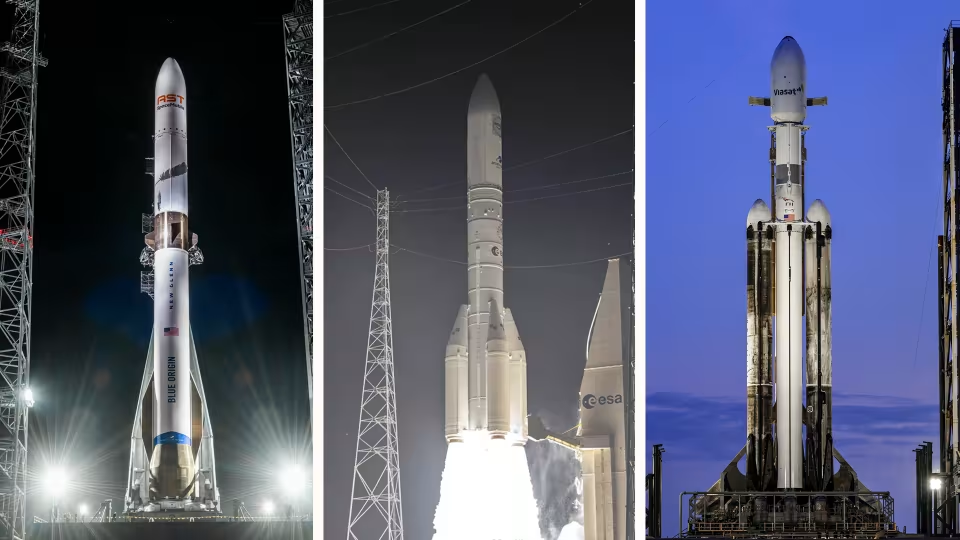
So far in 2026, 103 orbital rockets have been launched worldwide – roughly five launches per week. Spaceflight has truly become almost a daily routine.
Launches of Finnish satellites have also become commonplace: new ICEYE satellites were sent into orbit just last weekend aboard a Falcon 9 rocket.
However, even in this routine, some flights stand out as more significant than others.
One of the most anticipated recent launches was the third flight of Blue Origin’s new New Glenn rocket on 19 April. New Glenn is a partially reusable heavy-lift rocket expected to become a serious competitor to SpaceX. Its first stage lands on a droneship in the Atlantic after flight, just like Falcon 9 boosters, and can be reused.
On this mission, a previously flown first stage was used for the first time – and the landing was flawless. The booster performed perfectly and landed on Blue Origin’s droneship Jacklyn. The first test flight in January 2025 failed to land the booster, but the second flight in November 2025 succeeded.
The main payload was AST SpaceMobile’s large communications satellite BlueBird 7. Unfortunately, New Glenn failed to deliver it to the correct orbit. Although the launch and booster landing were successful, one of the two engines on the second stage did not perform as planned. As a result, the satellite was left in too low an orbit, could not raise itself higher with its own weaker engines, and re-entered the atmosphere roughly a day later, where it burned up.
The flight is therefore classified as a failure. New Glenn is now grounded until the cause of the issue is identified and fixed. Blue Origin had planned more than 12 launches this year, but that goal will not be met.
This may also affect the U.S. Artemis program and the return of astronauts to the Moon, as New Glenn was scheduled to launch Blue Origin’s own lunar lander test mission (Blue Moon MK1) in September.
You can watch the New Glenn flight here.
The next notable launch was the seventh flight of Ariane 6, which was also only the second flight of the heavier Ariane 64 version. The mission (VA268) took place on 30 April 30 from Europe’s spaceport in Kourou and successfully delivered 32 Amazon Leo satellites into orbit.
The flight was important for Ariane 6 and Europe’s independent launch capability, but also for Amazon, which must deploy 1,618 satellites by July 2028 to meet FCC requirements.
In addition to Arianespace, Amazon has contracts with ULA and SpaceX, and had planned to use its sister company Blue Origin’s New Glenn as well. However, both ULA’s Vulcan and Blue Origin’s New Glenn are currently grounded. This means Amazon will have to rely mainly on Ariane 6 and SpaceX in the coming months.
The third significant launch was SpaceX’s Falcon Heavy 12th flight on 1 May. The payload was the ViaSat-3 F3 communications satellite – a massive 6.5-tonne spacecraft destined for geostationary orbit to serve customers in Asia and the Pacific.
From a European perspective, this launch was also important because in April, ESA announced that the long-awaited Rosalind Franklin Mars rover will launch on a Falcon Heavy in late 2028 (October–December).
Watch the Falcon Heavy launch again here.
Russia also conducted an interesting launch on April 30. Soyuz-5 (Sunkar) is not a new version of the old Soyuz rocket, but an entirely new launcher designed to replace the Zenit in the medium-heavy category. It is capable of delivering approximately 17 tonnes to low Earth orbit.
The recent test flight was intentionally suborbital (ballistic). The rocket performed as expected.