
Smile! - You're in space
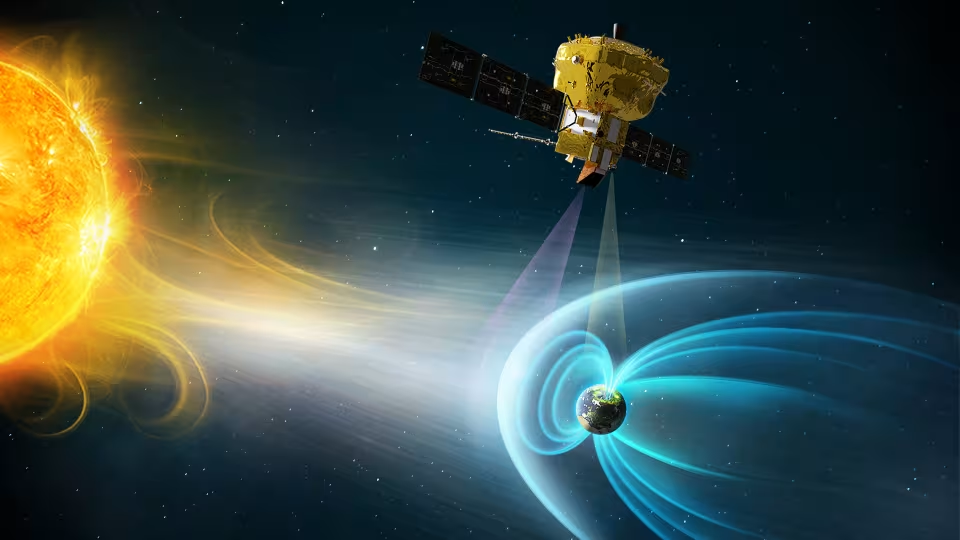
This morning at 5:52 CEST, a European Vega-C launcher successfully lifted off from Europe’s Spaceport in French Guiana, carrying the SMILE spacecraft. The goal of the SMILE mission is to improve our understanding of solar storms, geomagnetic storms, and space weather in general — topics of particular interest from a Finnish perspective.
Finland is participating on the scientific side of this joint mission between the European Space Agency (ESA) and the Chinese Academy of Sciences (CAS). Over 250 European and Chinese scientists form the consortium, including Finnish experts contributing to science planning, modelling, and ground-based support (for example, by coordinating with auroral and radar networks).
SMILE (Solar wind Magnetosphere Ionosphere Link Explorer) will reveal how Earth responds to streams of particles and bursts of radiation from the Sun. It will use an X-ray camera to make the world’s first X-ray images of Earth’s magnetic shield and an ultraviolet camera to observe the resulting northern lights continuously for up to 45 hours at a time.
The launch was also noteworthy as it marked the first Vega-C flight managed by the Italian company Avio. Previous Vega launches were operated by Arianespace in cooperation with Avio.
Following a nominal launch and separation, the first signal from SMILE was received by ESA’s New Norcia ground station in Australia. Shortly afterwards, the spacecraft’s solar panels deployed successfully, allowing it to begin generating power for its systems and instruments.
Over the next month, SMILE will gradually raise its altitude with 11 engine burns, eventually reaching a highly elliptical orbit that takes it as far as 121,000 km above the North Pole to collect data, before descending to 5,000 km above the South Pole for efficient data downlink to scientists on Earth.
Scientific data collection will begin in earnest in July, once the team has deployed the instrument booms, opened the camera covers, and verified that all systems are functioning as expected.