
NASA Outlines Its Lunar Base Plans – New Opportunities for Finnish Companies
Artemis II flight in April was the first time in over 50 years that humans had visited the vicinity of the Moon. For NASA and the United States, it was also a new beginning as it aims for the first landing of astronauts on the Moon's surface since the Apollo flights. If all goes well, astronauts could be on the Moon in 2028.
Before the April Moon flight, NASA outlined its lunar flight plans. It announced, among other things, a reorganization of the flights (e.g. Artemis III is a test flight in Earth orbit and only Artemis IV will attempt to land on the Moon) and that nuclear energy will be taken into use for flights towards Mars.
Now on May 26, NASA further refined its plans regarding the Moon. After the successful Artemis II flight, interest in the Moon has increased, as has the ongoing competition with China, which has become clearly visible.
If the United States does not hurry, Chinese space travelers, taikonauts, are likely to be on the Moon's surface before the Americans. China has developed its space capabilities and has already quietly and determinedly built lunar spacecraft for years.
NASA Administrator Jared Isaacman clearly referred to this geopolitical competition in the event, where – unlike the Apollo-era space race – it is not just about fame and glory, but also about gaining a foothold on the Moon – especially in its important and quite limited areas of interest near the South Pole.
There is probably water ice beneath the surface, which can be used to produce oxygen and fuel. On the high mountains in the South Pole region, there are also places where the Sun is visible almost continuously.
Isaacman stated that establishing a base helps secure U.S. interests, but he also promised that his country will adhere to the UN's so-called Outer Space Treaty that regulates the use of the Moon. The NASA-led Artemis Accords partner network, which reinterprets the treaty, is an essential part of this new strategy.
Finland is one of the signatory countries of the Artemis Accords.
One billion dollars for preparing lunar bases
The plans presented by NASA at the event are mainly about strengthening existing projects, but a concrete goal was now set for human presence in the Moon's South Pole region by 2029. This will happen first with robotic landers and then with crewed flights.
The first landing on the Moon's surface will most likely be made closer to the equator, as it is safer, but subsequent flights will target this mountainous and rugged corner of the Moon.
To achieve this goal, NASA announced several contracts with space companies, which are promised nearly a billion dollars worth of orders.
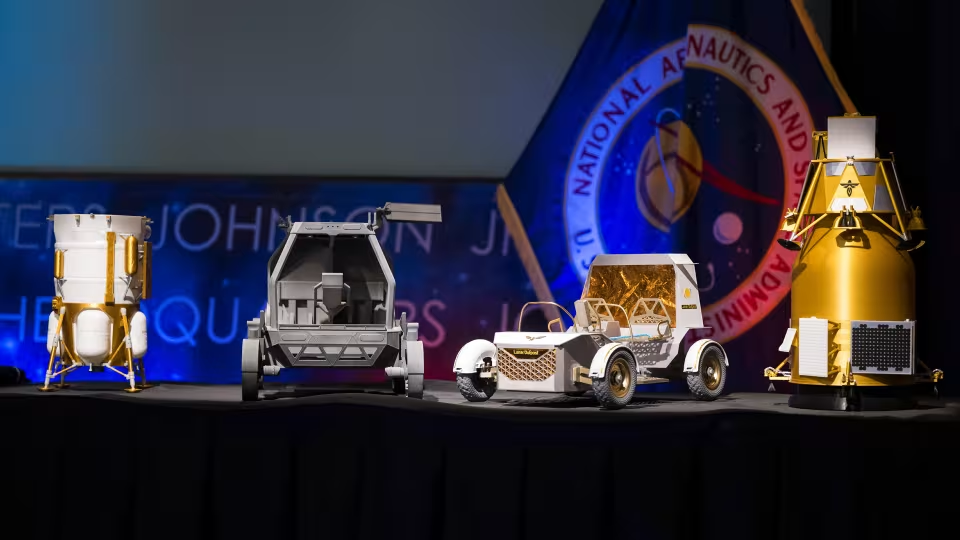
Two companies, Venturi Astrolab and Lunar Outpost, will each receive contracts worth approximately 220 million dollars for the development of lunar rovers, Lunar Terrain Vehicle (LTV). They will be able to move both autonomously and under astronaut control. The rovers are intended to remain operational on the Moon's surface for up to 10 years.
These have been in development for some time. Astrolab's FLEX will now receive a new name, Crewed Lunar Vehicle (CLV-1), and Lunar Outpost's vehicle, previously known as Eagle, is now called Pegasus.
These will be delivered to the Moon's surface using Blue Origin's Blue Moon Mark 1 landers. For each delivery, Jeff Bezos' space company will receive approximately 234 million dollars. The goal is to deliver the rovers to the Moon in advance, about two kilometers away from the places where the astronauts are scheduled to land.
With the help of these rovers, astronauts will initially be able to move within a radius of about 10 kilometers. Later, they can venture up to 400 kilometers away.
Blue Origin is also developing a lander for astronauts, as is SpaceX. Both of these are behind schedule, but the companies have promised NASA to accelerate their efforts. At the same time, the delivery of spacesuits for astronauts is also delayed. Axiom, which is responsible for this, has also promised to speed up the project.
Another announced novelty is the MoonFall technology demonstration.
Firefly Aerospace received a 75 million dollar contract to send the Elytra Dark lander to the Moon in 2028. It will carry jumping small vehicles that could swarm around the lander for about one lunar day (two Earth weeks), imaging and studying their environment. The purpose is to precisely map locations where astronauts will land.
As part of previous contracts, three NASA-ordered Moon flights will take place this year: if all goes well, Blue Origin's Blue Moon Mk.1, Astrobotic's Griffin-1, and Intuitive Machines' IM-3 will fly in late 2026.
NASA's goal is to begin systematically building infrastructure on the Moon, with the target of having at least a temporarily inhabited lunar base by 2032 at the latest.
What role international partners will play in this remains open for now. It is unlikely that a similar setup to the International Space Station and the (now canceled) Lunar Gateway will be seen; instead, NASA will make targeted cooperation agreements between different countries.
Finland has already had a small role in Moon missions so far: the radiation detectors from Turku-based ASRO were part of the Artemis I flight, and the company was also supplying them to the Lunar Gateway station. Perhaps they could be used on the upcoming lunar bases.
Solar Foods' food solutions would also be excellent for Moon missions.