Four proposed models for the future of Finland’s space administration
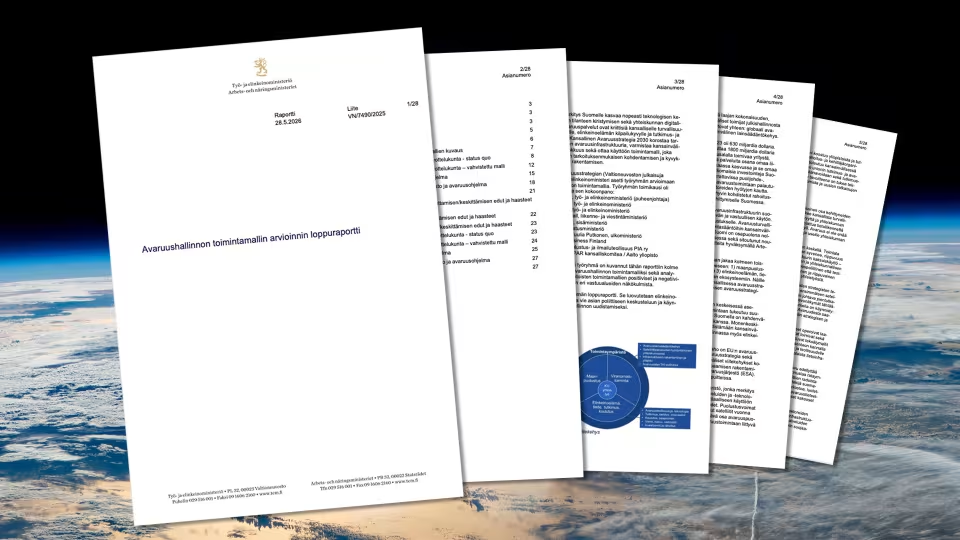
A working group tasked with evaluating the operating model of Finland’s space administration has submitted its final report on developing the operating model for Finland’s space administration to Minister of Economic Affairs Sakari Puisto. The report examines how the administration should be structured to meet the needs of a changing operating environment and how the role of the administration should be strengthened to promote the goals of the national space strategy.
The background is the rapid growth of Finnish space activities and the fact that the current decentralized administration is clearly unable to meet future challenges – at least in its present form.
In its press release (in Finnish), the ministry states that securing the operational capacity of Finland’s space administration requires strengthening the current operating model.
The working group – which included, among others, Professor Jaan Praks from Aalto University (who is also involved in the SpacEconomy project) and was led by Tero Vihavainen, Senior Expert at the Ministry of Economic Affairs and Employment (TEM) – reviewed the current decentralized operating model of space administration as well as three alternative models for strengthening it.
The report analyzes the positive and negative characteristics of the current and alternative models from the perspective of different areas of responsibility in the administration.
The outlined operating models are:
- The current operating model, i.e., decentralized space administration, with the Space Affairs Advisory Board (ANK) serving as a coordinating forum. Both the political and executive levels are decentralized.
- Alternative Model 1, which continues with a decentralized space administration where the Space Affairs Advisory Board (ANK) coordinates the implementation of the space strategy. The division of responsibilities in space administration would be enshrined in the legislative framework, and the resourcing of the ANK and its secretariat would be secured.
- Alternative Model 2, in which the political leadership and strategic coordination of space administration would be centralized in a new unit to be established. Substantive ministries would remain responsible for implementation, and the needs of different administrative branches would be coordinated within the framework of the space program. The executive level would remain decentralized in its current form.
- Alternative Model 3, in which a Space Agency and a national space program would be established. The political leadership and strategic coordination of space administration would be centralized in a new unit to be established, and implementation would be centralized in one agency.
The report now submitted serves as a knowledge base and an opening for discussion on strengthening space administration. The discussion on the necessary measures will continue across government departments and in cooperation with stakeholders.