
European satellites have been interfered with
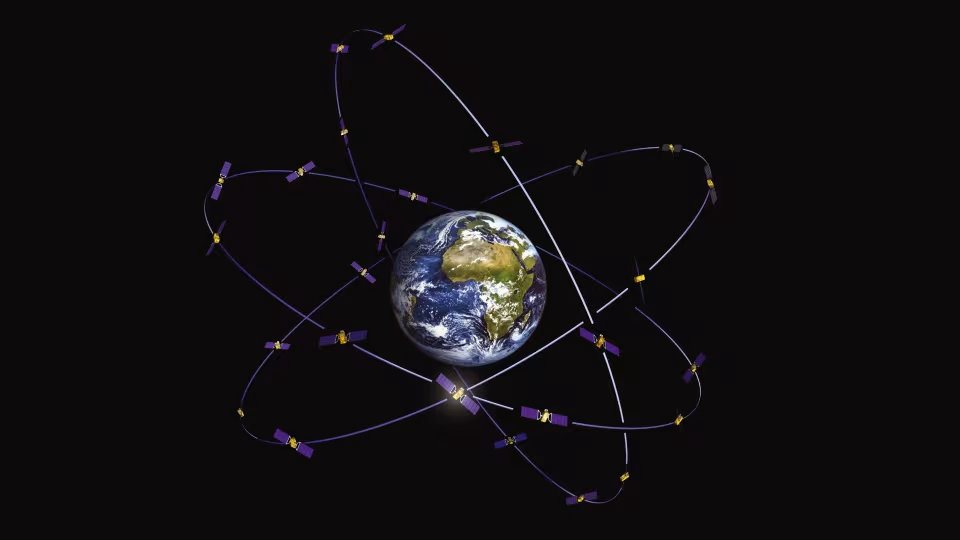
An interesting article appeared in Finnish business newspaper Kauppalehti yesterday, 8 October 2026, in which Timo Pesonen, Director-General of the European Commission’s Directorate-General for Defence Industry and Space, tells journalist Kreeta Karvala how hostile actors have tried to break the encryption codes of the European Galileo satellite navigation system - fortunately without success.
If hostile actors gained access to the codes, positioning could no longer be trusted, Pesonen says: a receiver could be made to show the wrong location. The article does not say when the attempts were made, who carried them out, or whether the target was PRS encryption, OSNMA or some other protected component. The open service PRN spreading codes are public in any case, but the codes for the most important services are secret.
What encryption?
OSNMA is a new way of authenticating the navigation message of Galileo’s open service (Open Service Navigation Message Authentication). It has been in use since 2025.
Ordinary satellite navigation broadcasts orbit and time data in the clear. A receiver cannot tell whether the data really came from Galileo or from a spoofing transmitter. OSNMA adds a signature made with Galileo’s private key. The receiver checks it with the public key and rejects the message if the signature does not match.
It therefore protects the navigation message, not the ranging measurement itself, which is based on the precise time signal transmitted by the satellite. An attacker can still falsify the signal’s timing unless the receiver also uses the forthcoming SAS (Signal Authentication Service), which authenticates the measurement.
OSNMA is free and does not require a separate agreement, but the receiver must be able to verify the signature.
PRS, in turn, is Galileo’s Public Regulated Service. It is not intended for general use, only for actors approved by EU member states, such as the armed forces, the police, border guards and other public authorities, and their contractors.
The signal is transmitted on different frequencies from the open service, and both the codes and the message are encrypted. A receiver needs an approved device and keys controlled by the state. Without them the signal cannot be used for positioning.
The aim is that PRS still works when open Galileo or GPS is jammed or spoofed.
Not only Galileo was targeted
In the same interview Pesonen says that the EU’s roughly 40 large satellites have been subject to interference attempts, and that in some cases satellites have been steered off their normal orbits. In every case it has not been clear whether the activity was deliberate or accidental. No satellites, orbits, dates or actor are named.
Scattered reports and rumours of interference have appeared in public before, but Pesonen described the events unusually directly. The Commission, EUSPA (the European Union Agency for the Space Programme) and the European Space Agency, ESA, have not commented.
Although this is not a direct act of war, activity of this kind in space is unfortunately already commonplace. The United States, Russia and China already operate satellites that can inspect other satellites at close range. In principle they could also affect a target by jamming it or even physically, for example by colliding with it. They can also eavesdrop on communications between ground stations and target satellites. Satellite operations can also be affected by interfering with ground stations and with the links to the satellites.
Space defence is needed
The issue is closely linked to the European Space Shield initiative being prepared by the European Commission, which is meant to protect the EU’s space systems better than today.
Ursula von der Leyen and the Commissioner for Defence and Space, Andrius Kubilius, presented it in September 2026 at the international space summit in Paris, but its roots are in the EU space strategy presented in 2023.
Kubilius has said that Europe cannot be defended without space, and has named the threats as radio-frequency interference, jamming, spoofing, suspicious close approaches and anti-satellite weapons. He has identified Russia as the main source. The same actor may be behind the cases Pesonen mentioned, but the interview does not go further into that.
In practice the European Space Shield would mean that the EU, its member states, NATO and civilian and military authorities would share:
- a space situational picture and satellite tracking
- interference alerts, including radio-frequency interference
- protection of Galileo and other EU systems
- the link between intelligence and warning systems and terrestrial defence
In September 2026 seven member states, led by France and Germany, demanded that the initiative be limited to the EU’s common systems. They do not want the Commission to build or operate genuine military space capabilities on behalf of the member states. Funding and the final division of tasks remain open.