
DA-Group joins Europe’s next-generation EPS-Sterna weather satellite programme
Located in Forssa, DA-Group is a quiet giant in the Finnish space sector. Founded in 1995, the company specialises in microwave technology and has designed and built equipment for dozens of satellites.
The most recent projects include the Sentinel-1 and MetOp-SG satellites, for which DA-Group has supplied RF subsystems and an 89 GHz receiver. Perhaps the most challenging order in the company’s history was the front- and back-end modules for the 70 GHz radiometers of the Low Frequency Instrument on ESA’s Planck space telescope, launched in 2009.
Now the company can add the ESA and EUMETSAT EPS-Sterna satellites to its list. DA-Group has just announced that it has signed a contract with the Swedish company AAC Omnisys for the delivery of radio frequency solutions. The work also involves Creowave Filters Oy, which belongs to the same group.
The components to be delivered are part of the microwave radiometer system developed by AAC Omnisys, where signal quality directly determines the accuracy of the measurement data.
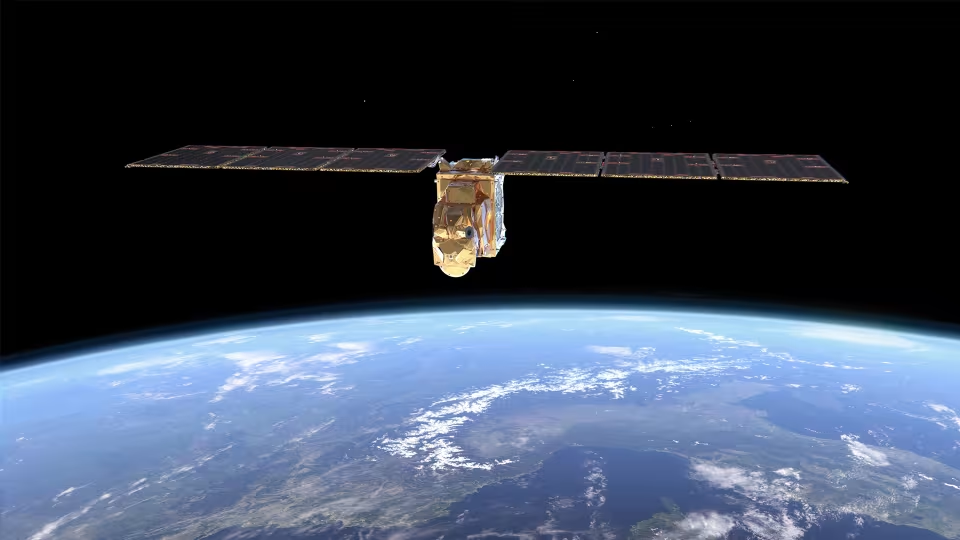
EPS-Sterna is Europe’s next-generation operational weather satellite system, based on ESA’s Arctic Weather Satellite (AWS). The AWS satellite served as a prototype and technology demonstrator for this new system. It was built quickly and cost-effectively, which has made the EPS-Sterna constellation significantly more affordable than traditional weather satellite systems.
Both AWS and EPS-Sterna satellites make observations especially of northern regions using precise microwave radiometers. These instruments can create a kind of three-dimensional cross-section of the atmosphere, determining temperature and humidity – key parameters for weather forecasting. Observations can be made in all weather conditions, including through clouds.
The system consists of 18 microsatellites (+ 2 backup satellites) that will be placed into three different polar orbits at an altitude of 595 kilometres. The satellites are small, with a mass of approximately 135 kg each, and have a planned operational lifetime of 5 years. With six satellites in orbit at any one time, the 18+2 satellite constellation will keep the system operational until 2042.
The first satellites are scheduled for launch in 2029.
The EPS-Sterna system is capable of mapping the entire Earth in five hours, and the data will be available to meteorologists with only about a one-hour delay.
The satellites are very Nordic in nature: the prime contractor is OHB Sweden, which has subcontractors – including now DA-Group. This means that part of the €248 million contract, as well as AAC Omnisys’s €76.3 million share, will also flow into Finland.