
Space Economy is surging – Finland is leading the Boom
What do satellites and sewers have in common?
In everyday life, we usually don’t think about either of them. They are invisible infrastructure that society relies on. They are essential, yet unnoticed. If the sewers stopped working, we’d be in trouble very quickly. If the satellites stopped working, we’d be in even deeper trouble – and much faster.
You can see pipes in bathrooms and sewer covers on the street, but hardly anyone pays attention to satellites. They are visible only as tiny moving dots in the night sky, yet their influence is networked across the world even more effectively than sewers.
Your phone’s map app works thanks to navigation satellites. The time signals sent by satellites synchronize everything from bank transfers to mobile networks. Data also travels via communication satellites. Thanks to weather satellites, storm warnings are more accurate than ever.
If the satellites were to suddenly go offline, the consequences would be immediate: traffic would descend into chaos without navigation systems, the internet would go down across large areas, and many TV channels would disappear. Within a couple of hours, payment systems and stock exchanges would slow down or stop. Within a day, air traffic would be grounded for safety reasons, mobile networks would collapse, there would be disruptions in electricity supply, and (hah!) even wastewater treatment plants would have to rely on backup systems.
If the situation continued for several days, store logistics would collapse, shelves would empty, and shortages of fuel and supplies would emerge. Global trade and financial flows would grind to a halt. Many countries would declare a state of emergency.
Fortunately, it is quite unlikely that all satellites would go offline at the same time. However, this worst-case scenario thought experiment clearly shows how deeply space is woven into modern societies around the world.
"New Space” is here
The vast majority of critical satellite systems are still built by governments and international organizations. Traditionally, virtually all space activity was state-driven, but over the past ten years the situation has changed dramatically: the absolute majority of satellites are now launched by commercial companies.
American company SpaceX, founded by Elon Musk, has been the pioneer and accelerator in this field. It has risen to become the world’s leading space player, with a massive lead. By early June 2026, 1,725 satellites had been launched into space on 126 rockets – of which 1,417 satellites and 65 launches were by SpaceX. China comes in second with around 125 satellites and 36 launches.
SpaceX’s Falcon 9 rockets currently account for over 80% of Western launches, and its Starlink communication satellites provide internet connectivity from the sky anywhere on Earth, including Finland.
While SpaceX is the largest, it is far from the only player. Its main emerging competitor is Blue Origin, founded by another billionaire, Jeff Bezos. Blue Origin also builds reusable rockets and is developing the Amazon Leo constellation, similar to Starlink. Both companies are also aiming for the Moon and beyond.
In the shadow of these giants is a wide network of smaller companies that are doing much of what space agencies and traditional aerospace giants did before – but faster, more agile, and more commercially.
Access to space is cheaper and easier than ever. There have also been major advances in satellite technology and a change in mindset: because launching new satellites is now affordable, they don’t all need to be built to the ultra-reliable standards of the past. This significantly lowers costs.
We can talk about a snowball effect, where everything accelerates everything else. Not only is launching satellites cheaper, but building them is also cheaper and easier as companies and service providers compete and develop the technology. Series production and standardization further streamline operations.
New ideas for satellite applications are easier to implement, and instead of a single satellite, small constellations can be launched. This means you no longer have to wait a long time for a satellite to pass over a specific location — one from the swarm is likely available soon. End users are happier.
The number of companies working with space, satellites, Earth observation, and related services has grown strongly. The so-called space economy is one of the fastest-growing sectors — and the sky is not the limit.
Finland as a pioneer of the new era
Space activities in Finland have traditionally been very modest, especially since space had a significant political role during the Cold War. As a neutral country, Finland wanted to stay out of it. Finland did not participate in Soviet cosmonaut flights but carried out its first space technology project safely with the Swedes. We only joined the European Space Agency at the beginning of 1995.
The idea of a Finnish satellite was long considered so crazy that in the 2010s, Aalto University engineering students were laughed at when they proposed building their own satellite. After long struggles and skepticism, the student group led by Jaan Praks successfully launched Aalto-1 in 2017 – and in doing so, shifted Finnish space activities into a higher gear.
The Aalto-1 project came at exactly the right time. While “New Space” was already rising in the United States, Europe was still operating in the traditional way. In the New Space mindset, building a satellite no longer had to be a large national project – it could be done even in a garage. And the most important thing wasn’t just the satellite itself, but what you did with it.
Two students involved in building Aalto-1, Pekka Laurila and Rafał Modrzewski, had the idea of founding a company to provide ice situation data for mariners. A small radar satellite could map frozen seas with sufficient accuracy, and since even a small improvement in ship routing could bring significant savings, the business model worked.
Today, ICEYE has launched over 70 satellites into space and is the world’s leading radar satellite company – as well as Finland’s and Europe’s spearhead in “New Space.” Ice imaging remains part of its name as a reminder of its origins.
Another company born from Aalto-1 is Kuva Space, which conducts hyperspectral observations from space. It was founded by Aalto alumni Tuomas Tikka and Janne Kuhno. There are many more indirect connections to current Finnish space companies, and even more people who have been inspired by the development sparked by Aalto-1.
Official Finland and funders have naturally joined in as well. Today, Finland has –depending on the counting method – several hundred companies operating in the space sector. In addition to actual space technology, they produce software, mechanics, and services based on satellite data, employing over 13,000 people. The main bottleneck for growth is a shortage of skilled workers – there simply aren’t enough experts in Finland or globally.
SpacEconomy drives the sector forward
Aalto-1 didn’t appear out of nowhere, it was built on academic research collaboration. While Aalto University was in charge of the satellite itself, the payloads were developed by the University of Turku, the Finnish Meteorological Institute, and VTT.
Finland’s impressive rise as a small space power might have been possible even without Aalto-1, but its example and mental encouragement were unique. That’s why, a decade later, Finnish universities and research institutes have regrouped to consider ways to give the sector a new boost.
Just like in the 2010s, the space sector is once again in transition. Instead of steady growth, we are now facing exponential growth. For example, SpaceX is already planning a constellation of one million (1,000,000!) satellites.
The strategic research project SpacEconomy brings together the forces behind Aalto-1 and expands the consortium according to recent developments and the needs of the industry. In addition to Aalto University, the University of Helsinki, the University of Turku, and the Finnish Meteorological Institute, the project also includes the University of Vaasa, Tampere University, and the Finnish Geospatial Research Institute (National Land Survey of Finland).
The consortium aims to develop Finland’s growing space economy by providing research data and strengthening the country’s talent base in the space economy.
The work packages focus on building an ecosystem for Earth observation and satellite navigation data, studying the commercialization of space, business models and ecosystem collaboration, and identifying growth bottlenecks. They also examine dual-use space applications from the perspective of societal resilience and explore ways to protect critical satellite-based services.
One of the project’s key goals is to anticipate how space technologies and artificial intelligence will shape Finland’s economy, well-being, and resilience. Based on this, policy recommendations and a roadmap for developing the space economy will be made for decision-makers.
Finland’s general economic development in recent years has been weak and sluggish, but the space economy has been a clear exception. Growth over the past three years has exceeded 20%, and as ICEYE perfectly demonstrates, Finnish companies have the potential to rise among the world’s leading players.
That said, the success of ICEYE and other Finnish space companies has also been accelerated by an external factor: war.
Increased defense needs and Europe’s push for greater self-sufficiency in space have brought many orders and opportunities to the entire sector. One reason the United States and China lead in space is their investment in military space use. Europe’s growing defense-related space activity is therefore also strengthening the broader European space industry.
National security is also a cross-cutting theme in SpacEconomy, as space-based services in addition to hardware strengthen security in our society.
Growth, expansion, and reaching further
When we talk about space, we usually think only of satellites, rockets, and the data they send and process. Finnish space companies are involved in all of this (though not yet building rockets themselves – rocket engines, yes). But space is much more than that.
As access to space becomes constantly cheaper, even seemingly crazy projects are becoming possible. For example, the European Space Agency’s Finnish business accelerator recently selected Farsight, which plans to send space telescopes into orbit for amateur astronomers. Another Finnish company, ReOrbit, is involved in sending data centers into space. Zero Gravity and Sharpnav are developing new types of thermal imagery and navigation satellites.
Astronaut Tim Kopra, the famous Finnish-American “sisunaut” who moved from NASA to the private sector, visited Finland in May and presented the space station planned by the company Voyager, which he represents. In the United States, there are already three companies conducting private spaceflights: Voyager, Axiom, and Vast. Before building their own stations, they fly missions to the International Space Station. Axiom has already completed four flights, two of which included Europeans, including Swedish astronaut Marcus Wandt.
Wandt, selected as a European Space Agency reserve astronaut in 2022, flew in 2024 largely thanks to Sweden’s own initiative and funding. Sweden saw the flight as necessary to spark interest in space. Historically, Sweden has been far ahead of Finland in space technology, but in recent years it has fallen clearly behind.
Finland does not yet have its own astronauts, but the coming era of private space stations will bring many new opportunities for Finland – and not just for astronauts. Space tourism (which commercial institutional astronauts like Wandt also practically represent, in addition to flying wealthy passengers) is only a small part of the future space economy. The most promising area is industrial production in space.
In microgravity, it is possible to manufacture metal alloys and pharmaceutical molecules that cannot be made on Earth’s surface. Higher-quality optical fibers and larger silicon wafers can be produced. There is abundant solar energy available, and in the future, materials can be mined from the Moon or asteroids, eliminating raw material shortages. Almost anything could be done in space more cheaply and better.
Finland could also participate in launching space industry, as good ideas are the most important thing at this stage. No one yet has factories in space.
Although attitudes toward sending humans into space are still quite skeptical in Finland, it is clear that humanity will gradually move into space as well. First near Earth, then to stations on the Moon’s surface, and eventually further out. In the long term, this will shift the entire Earth’s economy increasingly toward – and into – space. The space economy will literally become the economy of space.
This will happen well after the SpacEconomy project ends, but it is worth laying the groundwork for the future in this field in Finland already now. And that is exactly what is happening: ASRO’s radiation monitors have flown around the Moon on NASA’s Artemis mission, and Solar Foods’ miracle protein Solein is already on its way to astronauts’ tables.
Solein is made from carbon dioxide, hydrogen, and nutrients that microbes use in a bioreactor. Spacecraft benefit from removing carbon dioxide from the air, and water is already extracted from waste on the space station. After purification, it is also drunk – and the same water could serve as a raw material for growing food.
And who is needed to build such systems? Sewer engineers, of course! The connection between space and wastewater treatment is not only philosophical but also very concrete (and it is also part of the SpacEconomy project).
(The text was published in Finnish as a blog post on the website of the WELEC program – Strategic Research on Economy and Welfare in the Age of Strategic Competition – of which SpacEconomy is one of five projects.)
---
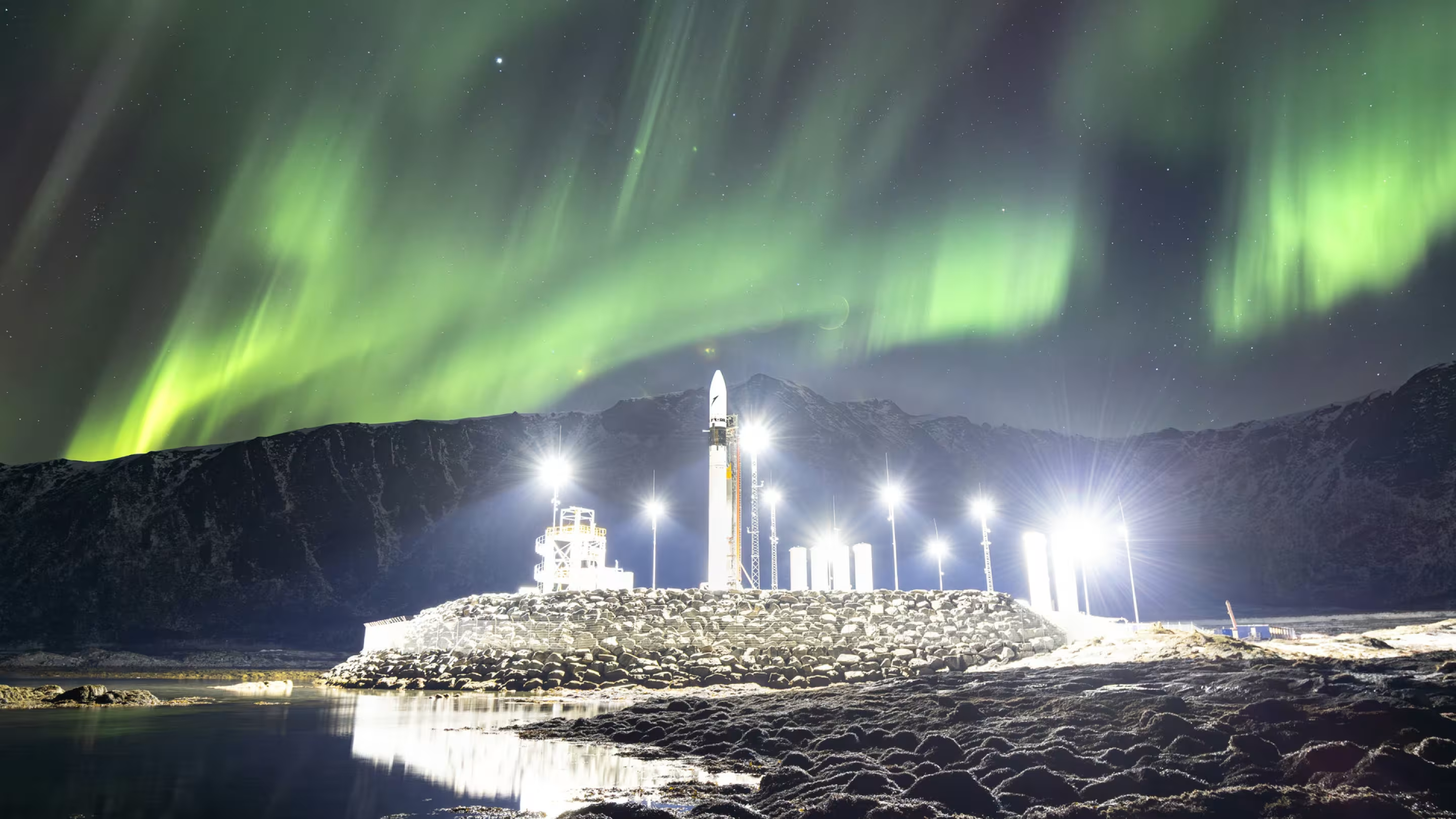
The header image shows a rocket from the German company Isar Aerospace on the launch pad on the island of Andøya in Norway’s Lofoten Islands. Finland is not part of the project, but launching satellites right next door clearly shows how the world is changing – and how space activities in their various forms are getting closer to Finland as well.
Photo: Isar Aerospace