Rocket News: Ariane 64 flew nicely, and goodbye, Orbex
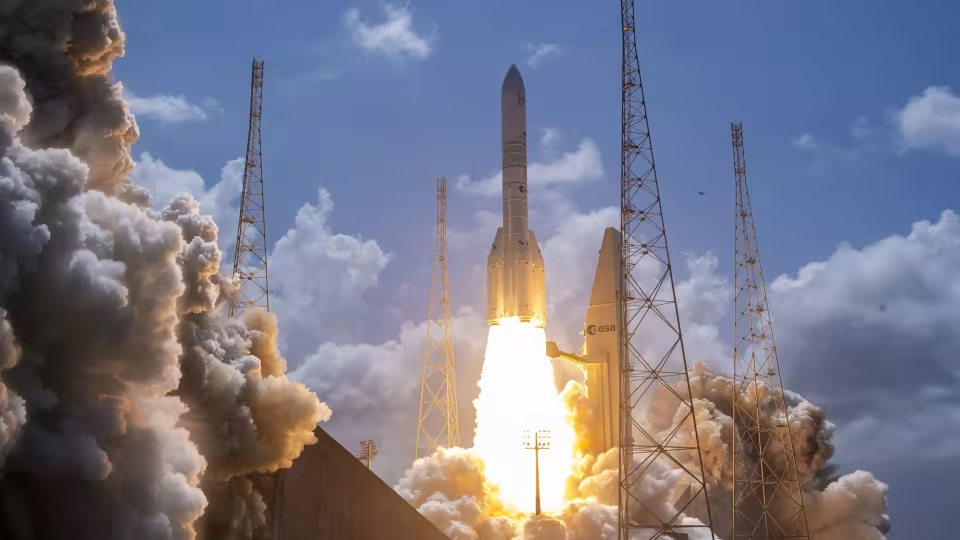
A lot has been happening recently in the space launch sector. The most recent – and perhaps most significant – event was yesterday, 12 February, when the heaviest version of Ariane 6, the Ariane 64, made its first flight.
Equipped with four solid-fuel boosters, the rocket carried 32 satellites for Amazon’s Project Kuiper (Amazon LEO) communications constellation into space. This was also the first fully commercial flight of Ariane 6; the five previous Ariane 6 launches had carried institutional European satellites.
Amazon has ordered a total of 18 Ariane 6 launches for its LEO satellites. Altogether, Amazon has reserved more than 100 launches from four different companies to deploy over 3,200 satellites. Of these, 214 are now in orbit, as seven earlier launches by American rockets had already placed satellites in space before this Ariane mission.
Ariane 64 can carry approximately 20 tonnes to low Earth orbit. With the larger of its two payload fairing options – as used on this flight – the rocket stands 62 metres tall, with 20 metres of payload volume.
Watch Ariane’s elegant launch in Arianespace’s video.

The VA267 mission logo. Image: Arianespace.
In the UK: Skyrora may acquire troubled Orbex
At the same time as Germany’s Isar Aerospace prepares for the second test flight of its rocket, and another German company, Rocket Factory Augsburg, continues preparations for its own maiden launch, their British competitor has run into difficulties.
The UK-based launch services company Orbex entered insolvency proceedings after a planned merger with the Franco-German company The Exploration Company collapsed.
The companies negotiated the deal in late 2025 and signed a letter of intent in January. Soon afterward, Orbex was forced to close its rocket engine factory in Denmark, lay off 90 employees, and the subsidiary operating the factory filed for bankruptcy.
In early February, Orbex formally initiated insolvency proceedings, putting approximately 150 UK-based employees at risk of redundancy. According to the company, fundraising and merger negotiations had not produced a viable outcome.
CEO Phil Chambers described the decision as a major disappointment, as the company had been close to conducting the first test flights of its Prime rocket. During the insolvency process, a buyer may be sought for the entire business or parts of it. Without significant new investment, both the Prime rocket and the larger Proxima rocket under development may never reach the launch pad.
However, some hope may come from another British rocket manufacturer, Skyrora.
The Glasgow-based company is considering acquiring selected parts of Orbex. Of particular interest is the Sutherland launch site in northern Scotland. Until now, Skyrora has planned to use SaxaVord Spaceport in the Shetland Islands – located in the far north of the United Kingdom – but the mainland-based Sutherland site would be more convenient.
According to Skyrora, a potential deal could involve an investment of up to £10 million and would ensure that Orbex’s technology and the Sutherland spaceport remain under British ownership. The company also emphasizes its intention to safeguard projects that have received public funding.
Orbex has employed around 160 people and has been one of the most interesting new European companies developing orbital launch vehicles. Unfortunately, it now appears to be the first of these to throw in the towel – at least under its own name.

Orbex Prime. Photo: Orbex.