
Odin, an important satellite in Finland’s space history, turns 25 – and is still operating
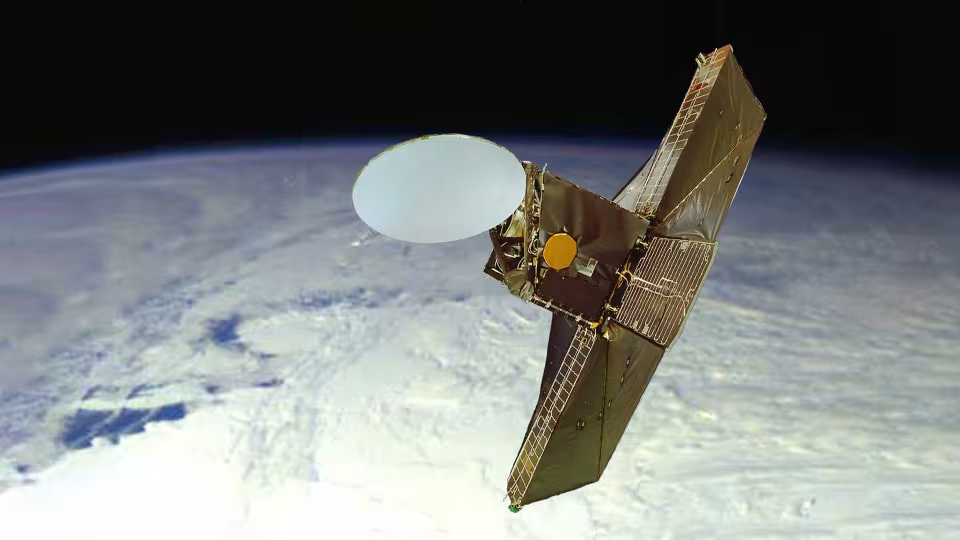
The Swedish Odin satellite will celebrate its 25th anniversary on 20 February 2026. Finnish researchers and companies have made a significant contribution to the project, which has in turn helped pave the way for Finnish participation in international space missions.
Launched into space in 2001, the Odin satellite was originally designed as a two-year mission, but it is still operational and has exceeded its initial expectations many times over. The satellite was launched from Russia into an orbit at an altitude of 600 kilometers, carrying two instruments: the SMR radiometer and the OSIRIS optical spectrometer.
The satellite has been used for both astronomical measurements and observations of Earth’s atmosphere, as well as for climate change research. In addition to Sweden, Finland, Canada, and France participated in the construction of the satellite.
Odin opened the door to space research for Finland
Odin was a significant project during the early stages of Finland’s space activities. It was the first satellite project in which Finland participated as a full partner through funding from Tekes (now Business Finland). Participation opened a pathway for Finnish researchers and companies to take part in demanding international space projects.
Finnish research institutions involved in the project included the Finnish Meteorological Institute, the University of Helsinki, and Helsinki University of Technology. The project laid the foundation for Finnish space astronomy and atmospheric research. The expertise and technology developed in the project have also supported the advancement of high-frequency telecommunications and radar systems.
A long, continuous measurement record is valuable for climate research
The Finnish Meteorological Institute plays a key role in processing measurement data from the OSIRIS spectrometer. OSIRIS measures vertical profiles of the atmosphere, such as ozone, aerosols, and temperature. In recent years, the Institute has particularly developed long climate time series for the middle atmosphere using OSIRIS measurements. A continuous 25-year measurement record is exceptionally valuable when studying the recovery of the ozone layer and the impacts of climate change.
“The long and continuous measurement record of the Odin satellite is unique from a research perspective. It helps us distinguish natural variability from long-term changes and improves our understanding of how the atmosphere responds to climate change,” says Head of Unit Johanna Tamminen from the Finnish Meteorological Institute.
OSIRIS measurements are also utilized in the European Union’s Copernicus Climate Change Service as well as in international assessments describing the state of the climate.
The Finnish Meteorological Institute participates in the SpacEconomy project, and Johanna Tamminen leads its Work Package 1.
Significant observations on ozone and the upper atmosphere
Over the years, Odin has produced significant observations on the state of the atmosphere. As early as autumn 2002, the satellite was used to monitor the exceptional splitting of the Antarctic ozone hole into two parts. The measurements have also been used to monitor the ozone situation in the Arctic region.
Originally planned as a two-year mission, the satellite is one of the longest-operating atmospheric research satellites. Hundreds of peer-reviewed scientific articles have been published based on its observations, and the data are widely used in international research.
This text is a press release from the Finnish Meteorological Institute.