
Five New Space-related Startups Join ESA BIC Finland
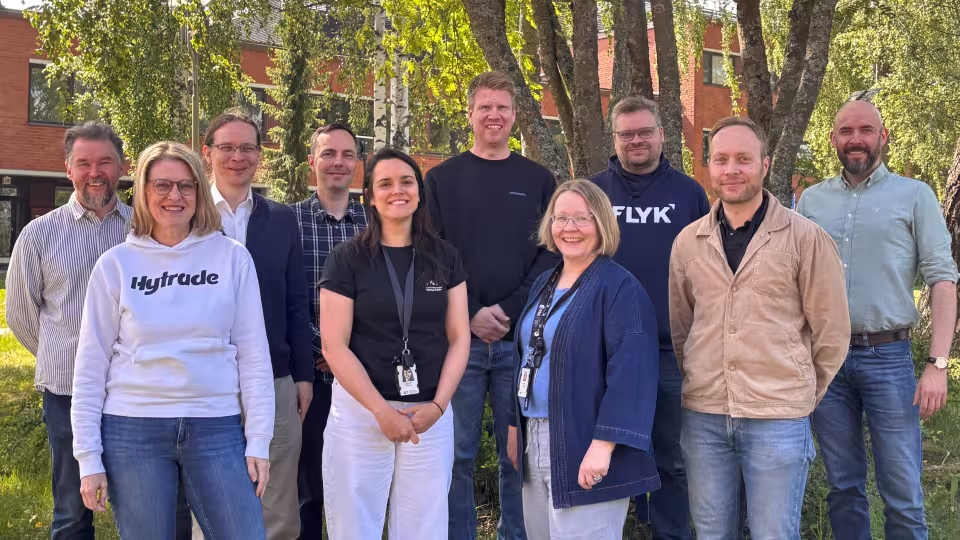
ESA BIC Finland, one of the SpacEconomy partners, announced a new round of early-stage companies that have been accepted to join the European Space Agency’s business incubation programme, further broadening the spectrum of space-driven entrepreneurship in Finland.
As part of ESA’s pan-European Business Incubation Centres (BIC) network under the ESA ScaleUp initiative, ESA BIC Finland runs two competitive application rounds each year to attract startups with distinctive space-linked business ideas. Eligible companies must be registered in Finland, be less than five years old, and show a clear link to the space sector – whether developing upstream solutions that support in-orbit and deep-space missions, or leveraging downstream assets such as navigation services or satellite data.
The programme is led by Aalto University in Otaniemi, Espoo, with the support of the University of Vaasa and active city collaborations across Helsinki, Espoo, Tampere, and Turku.
Selected startups receive tailored business coaching in financing, communications, marketing, and team development, as well as access to technical know-how through partner organisations. They are also embedded in the international networks of Aalto University Startup Center, ESA BIC, and Finnish partners, opening doors to customers, mentors, and investors.
Financial support of up to EUR 90,000 – jointly provided by ESA and Business Finland – helps accelerate product development and market entry over the course of the programme, that can last up to 24 months.
“Across Europe, ESA’s Business Incubation Centres provide a unified framework of networked support—giving startups access to ESA’s technical guidance, business services, and pathways to markets and partners,” said Kaisa Ahonen, Manager, ESA BIC Finland.
“This Europe-wide community complements our local coaching and funding in Finland, ensuring founders can validate their technology, refine their business models, and connect with the right stakeholders faster. The European-wide pool of experts in ESA networks is at their use”
The cohort of startups joining ESA BIC Finland in June 2026:
- Einbus predicts mobility demand, plans new routes, and connects transport operators, passengers and travel organizers in one platform.
- Farsight Space Telescopes develops agile satellites, telescopes and software for on-demand observation of objects in Earth orbit and beyond.
- Hytrade provides AI-driven SaaS solutions to optimize electricity production, consumption and trading in volatile power markets.
- Sensible 4 develops retrofit autonomy and supervised-autonomy systems for heavy industrial vehicles operating in harsh off-road environments.
- Sinapse makes robotics, IoT and space education practical, accessible and classroom-ready.
The newly selected companies see the space economy in Finland and Europe as a new spearhead for innovation.
“Finland has become a very credible space ecosystem: fast, commercially serious, and punching above its weight. For us the exciting shift is that value is moving to the downstream data layer, and the energy transition is creating real demand for exactly that”, comments Anne Särkilahti, CEO of Hytrade.
“Europe has world-class space infrastructure, and the next big opportunity is turning it into a practical industrial advantage. Galileo HAS is a strong example: a sovereign European capability that can improve positioning, safety and deployment speed for ground autonomy”. says Margarita Khartanovich, CMO & Co-Founder at Sensible 4.
These startups join a prestigious network alongside previous participants like Solar Foods, Kuva Space, Aurora Propulsion Technologies, Zero Gravity, Elfys, and WinsePower.
These alumni companies’ path has taken them to several ESA commercial projects, CASSINIand NATO Diana accelerators and even the Helsinki Stock Exchange. ESA Phi-Lab Finland has also funded four ESA BIC Alumni in their journey to commercialize geospatial technologies.
Applications for the next cohort will open in the coming months. Early-stage teams and startups working with space technologies or data – from upstream hardware and services to downstream applications—are encouraged to apply.