
First Celeste satellites launched to explore LEO-based satellite navigation
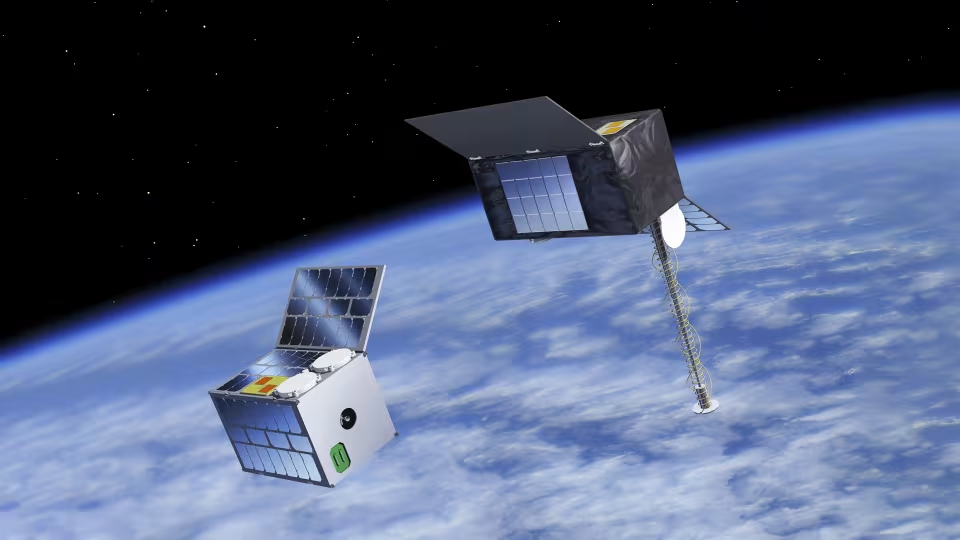
The two first satellites of the Celeste in-orbit demonstration mission lifted off today from New Zealand aboard Rocket Lab’s Electron. Their mission is to begin testing a complementary low Earth orbit layer for Galileo.
With Celeste, the European Space Agency takes a major step forward in strengthening Europe's ambition for more resilient satellite navigation.
The two satellites were built respectively by GMV and Thales Alenia Space. They validate core technologies and new signals and service capabilities and will bring into use the required frequencies in L- and S-band signals for the mission’s operational phase, in adherence to International Telecommunication Union regulations.

Additional launches in 2027 will bring the mission to its full configuration of 11 spacecraft (and one spare satellite) in orbit offering a wide range of experimentation opportunities in different frequency bands, user environments and applications.
By flying closer to Earth, Celeste offers the opportunity for more robust signals and new frequencies. The mission will offer an in-orbit test bench for a broad range of applications, such as enhanced navigation capabilities for autonomous vehicles, railway, maritime, and aviation, increased availability in urban canyons and remote polar and arctic regions, enhanced positioning and messaging with emergency services during disasters, tracking of connected devices and Internet-of-Things applications, and even indoor navigation.
Ultimately, the results of the Celeste mission will prepare European industry and support the European Union’s decision towards the establishment of an operational navigation layer in LEO, complementing Galileo and EGNOS, Europe's current position, navigation and timing systems.