
Finnish Meteorological Institute’s Emission Observatory Platform Selected for Sitra’s “Most Interesting” List
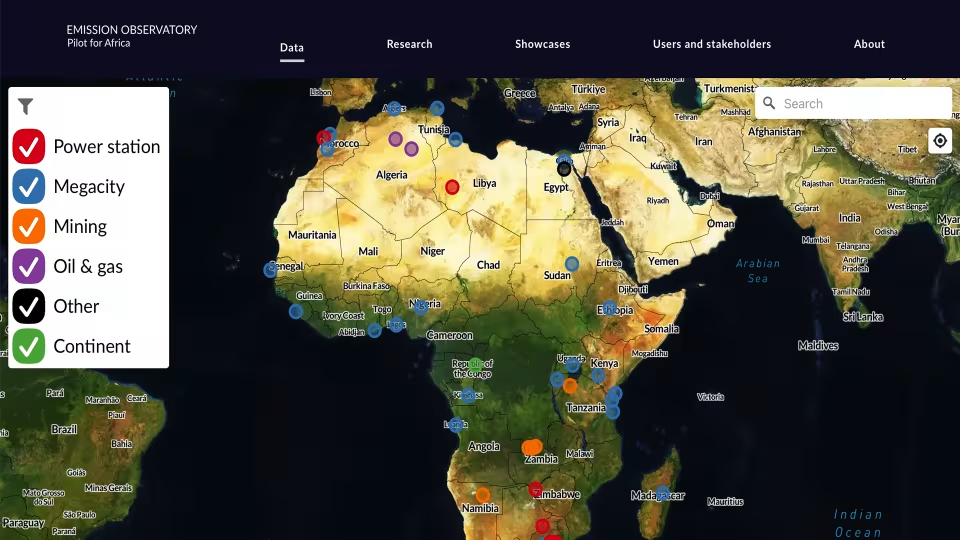
The Emission Observatory platform, being developed at the Finnish Meteorological Institute as part of the SpacEconomy project, has been selected for Sitra’s “Most Interesting in the Data Economy” list.
Emission Observatory is a satellite-based service that monitors human-caused greenhouse gas and air pollutant emissions. It produces transparent and improved emissions data, especially for areas where measurement networks are sparse or reliable information is not available.
Global greenhouse gas emissions have continued to rise in the 2020s. Although emissions growth slowed during the pandemic, overall emissions have since recovered and exceeded previous levels. Current developments are not in line with the Paris Agreement’s 1.5°C target and would require rapid and targeted emission reductions.
However, decisions related to climate and air quality are still often based on incomplete information, as measurement networks only cover limited areas or reliable data is unavailable. At the same time, expectations for transparency and accountability are increasing.
Satellite observations offer a new type of data to address this challenge, and they form the basis of the Finnish Meteorological Institute’s Emission Observatory. By observing the atmosphere from above, it is possible to monitor large areas consistently and in near real-time — including locations where ground-based measurements are scarce.
Emission Observatory Makes Emission Hotspots Visible
The service focuses on so-called emission hotspots — areas and activities where emissions are significant or where their development is particularly important.
The main focus sectors are mining, the energy sector, megacities, and the oil and gas industry.
“These industries directly affect both climate and air quality,” says Iolanda Ialongo, postdoctoral researcher at the Finnish Meteorological Institute.
“Their emission trends impact large populations and entire regions, which is why transparent and up-to-date information about them is especially important.”
The service is being piloted in Africa, where urbanization and industrial activity are growing rapidly, but emissions-related measurement data is often inadequate. However, since satellite datasets are globally comprehensive, the solution is not tied to any specific geographic environment.
“The service has been built so that new satellite datasets can be added as needed. This enables its development and use in different environments and across the world.”
Finnish companies have already made use of the solution. For example, in Tsumeb, Namibia, the service helped the Finnish company Outotec verify that their sulfuric acid plant was operating as planned and that emissions had decreased as expected. The results were used in Outotec’s sustainability reporting.
How the Solution Works in Practice
In practice, Emission Observatory utilizes open observation data produced by satellites. Experts at the Finnish Meteorological Institute analyze the data using scientific methods and modeling to identify emission sources from concentration observations and to estimate the quantity and trends of emissions.
The analysis also takes wind conditions into account. The processed information is published on the Emission Observatory platform, where users can view emissions on a map and compare them across different regions and sectors.
Information for Multiple Target Groups
Emission Observatory is designed to serve a wide range of users. Key beneficiaries include authorities and decision-makers who need up-to-date information to support environmental policy. Authorities are also responsible for monitoring the environmental and climate impacts of human activities.
For companies, the service provides insight into emission trends, making it easier to report environmental impacts and sustainability, as well as to verify compliance with environmental regulations. The solution has already been used successfully to verify emission reductions:
“Based on Emission Observatory, we know that sulfur dioxide emissions from the Tsumeb copper smelter in Namibia have decreased significantly,” Ialongo says with delight.
“Emissions dropped from approximately 90,000 tons per year to zero after cleaner technology solutions were implemented in production.”
On the other hand, the results have also identified locations where emissions have increased or remained largely unchanged.
Satellite data can naturally also be used in research, education, and teaching.
Information on Security and Societal Crises
While Emission Observatory focuses on monitoring emissions, the underlying technology can also provide new insights into security and the impacts of societal crises.
“For example, in Sudan, Emission Observatory detected a significant drop in nitrogen oxide emissions after 2023, when the civil war affected the operation of an oil refinery and the Khartoum region, as well as population displacement. Similar effects have been observed in Ukraine using similar satellite-based technology.”
This case demonstrates that satellite-based emissions monitoring can provide information not only on environmental and climate impacts, but also on broader societal changes and crises.
“Satellite observations have also been useful in monitoring fires at oil terminals on the eastern side of the Gulf of Finland and the smoke spreading from them. This kind of information supports authorities’ situational awareness and decision-making, for example in issuing warnings to citizens.”
In a Nutshell
Emission Observatory is a satellite data-based service for monitoring human-caused greenhouse gas and air pollutant emissions. It produces transparent and better emissions information, particularly for areas with sparse measurement networks or where reliable data is unavailable. Anyone can use the map service to view emissions from different industries and geographic regions. The service is currently being piloted in Africa.
Emission Observatory was developed as part of the Academy of Finland-funded Proof of Concept 2023 project. The platform is currently being maintained and further developed as part of the SpacEconomy project.