
Starship’s 13th test flight succeeded (almost)
SpaceX’s new large space rocket Starship completed its 13th test flight in the early hours of 25 July Finnish time.
The flight went excellently, except that the rocket’s first stage was unable to perform a simulated landing in the Gulf of Mexico near the launch site and instead hit the sea at a much higher speed than planned. Some of the engines intended for the landing burn did not start as planned.
The stage did, however, lift the rocket’s upper stage, Starship vehicle number 40, onto its path toward space, and the vehicle itself climbed with its own engines onto a trajectory that took it into space but had not reached orbital velocity that would have kept it circling the Earth.
This was intentional, as the test flight was conducted on a suborbital trajectory for safety reasons, so that the vehicle would come down from space to the desired location even if the rocket engine used for orbital adjustment failed. The engine was tested this time and worked well.
Otherwise, Starship’s flight proceeded exactly as desired. It released 20 fully functional, real Starlink satellites into space. These were new third-generation satellites that can only be launched into space by Starship. The satellites deployed, began operating normally and joined the Starlink network, but because they were on the same trajectory as Starship, they were destroyed at the end of their short flight.
This nevertheless confirmed the operation of the satellites and the deployment system.
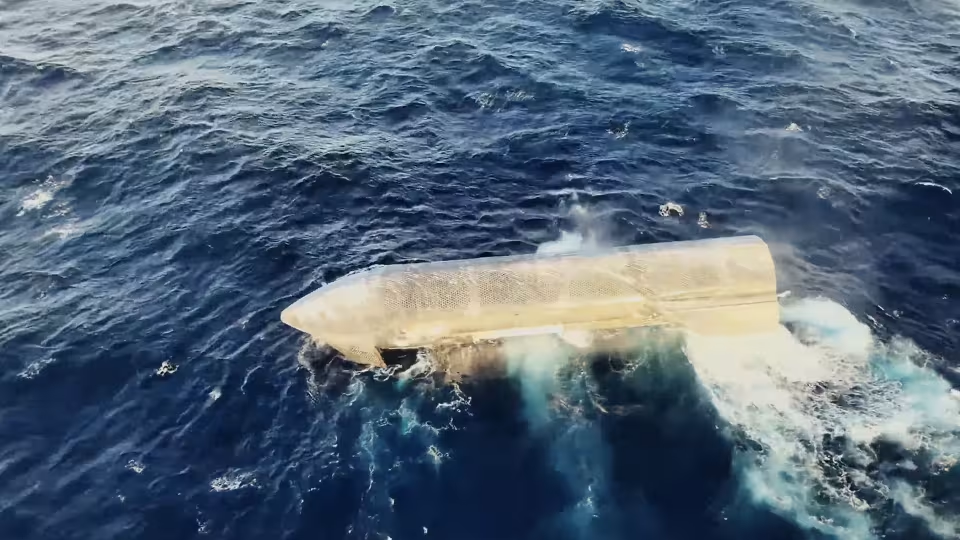
At the end of the flight, Starship returned to the atmosphere in the now-familiar manner and landed in the Indian Ocean at precisely the intended point, where it was already being awaited. Unlike previous flights, the landing was so soft that the vehicle ultimately did not explode upon hitting the water but remained floating on the surface.
Particularly good information and detailed images were obtained about the performance and durability of Starship’s heat-shield layer.
The flight went so well that the next test flight is planned for August 2026. At that time the vehicle will be lifted into low Earth orbit and an attempt may possibly be made to land it directly next to the tower on the launch pad.