
Happy 60th birthday, ESRANGE!
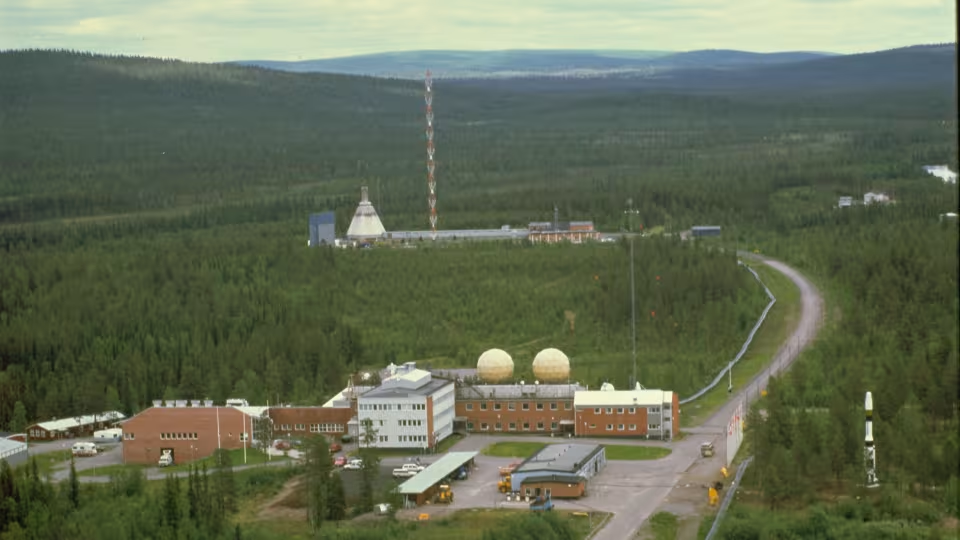
In our dear neighbouring country Sweden, up in its Lapland, right by Kiruna, lies one of Europe’s most important space centres: ESRANGE. Today, 24 September, it turns 60; it was officially established on 24 September 1966, and operations there got properly underway a couple of months later.
Over six decades, more than 600 sounding rockets and some 700 stratospheric balloons have been launched from the site.
The sounding rockets used in microgravity and space research climb into space, even above a thousand kilometres, but then return straight away to the large safety area around ESRANGE. During the flight, the research instruments inside the rocket spend more than ten minutes — sometimes even about 20 minutes — in free fall, or “weightlessness” (strictly speaking, microgravity). Because the rockets fly through the atmosphere and above it, the flights can also be used to observe, for example, the upper atmosphere, which is otherwise hard to study.
Stratospheric balloons, for their part, can be gas balloons the size of an ice hockey arena, carrying research payloads of several tonnes beneath them. They typically look up into space or study the atmosphere; because conditions above 30 kilometres are in practice very space-like, the flights are also used to test instruments that will later be installed on satellites.
SSC Space, a company under Sweden’s space authorities, has operated ESRANGE since 1972.
ESRANGE is also Sweden’s most important satellite control and receiving centre. It now has more than 40 antennas used to receive data from satellites and to control a number of them. The area also hosts a European Space Agency satellite station.
The Arctic location, the large recovery area for rockets and balloon payloads, and the centre’s good infrastructure make ESRANGE one of Europe’s most important specialised space facilities.
The reason ESRANGE was founded goes back to ESRO (the European Space Research Organisation), one of the predecessors of the European Space Agency. In the early 1960s it chose Kiruna as a research site in the auroral zone. The aim was specifically to launch rockets from below into the aurora region — that is, into the northern lights — at the same time as they were being studied from the ground and from space. Construction began in 1964, and the first sounding rocket was launched on 20 November 1966.
In recent years, test stands have been built at the centre for European rocket companies, including engine testing for Isar Aerospace’s Spectrum rockets. The new European reusable rocket demonstrator Themis will also soon make its test flight from there. The flight is only a short hop, but it is aimed at going higher.
ESRANGE is aiming higher as well, as preparations are under way for launching rockets that reach orbit. The first may be the American Firefly Aerospace in 2028.