
ESA's latest environment report is really worrying
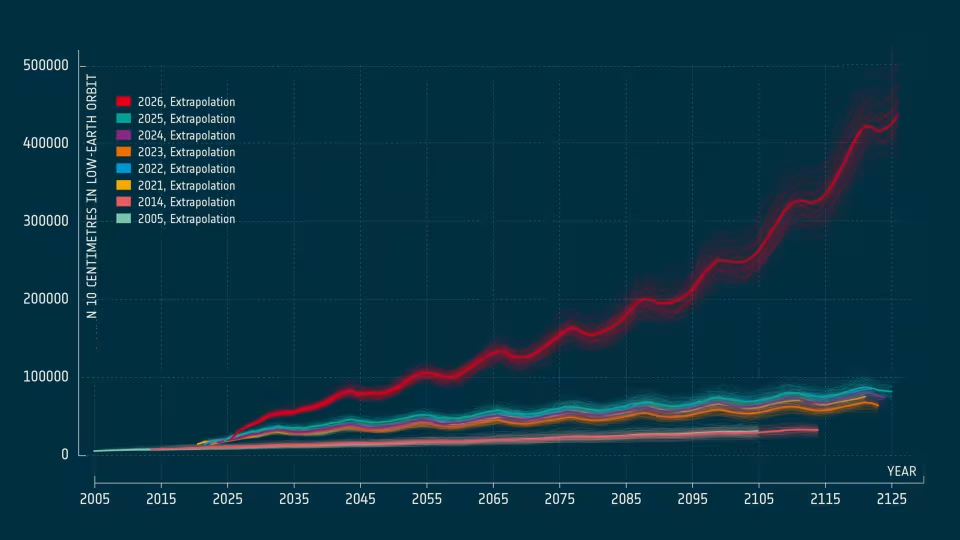
ESA's latest environment report, published last week, describes the state of near-Earth space based on data through the end of 2025. This ESA Space Environment Report 2026 is the annual review by ESA’s Space Debris Office of space traffic and the management of space debris.
The most important point in the report concerns commercial satellite constellations, which grow every year and about whose growth a great deal of additional information emerged during 2026. Because too few constellation satellites leave congested orbits at the end of their lives, the collision risk keeps rising.
On average, more than three intact satellites or rocket stages now re-enter the atmosphere every day. At the same time, about ten new payloads are launched each day. In 2025, some 1,200 intact human-made objects re-entered the atmosphere.
The report also introduces a new metric: the risk of becoming a casualty from a re-entry. The figure is still small compared with other everyday risks, but it is rising all the time.
The “health index” rose from 4 to 50
The ESA report also assesses and quantifies how sustainable space activity is over the long term.
During 2025 the index rose from about four to 50 — an order of magnitude worse. The main reason is the larger projected future satellite population driven by constellation growth. In a “business as usual” scenario the risk would be about 50 times the sustainable threshold.
The time horizon of the future projections was shortened from 200 years to 100; even so, the numbers of objects and collisions in LEO rise sharply, even if constellations follow minimum practices.
How many objects are in space?
The report also gives the latest figures for satellites and other objects orbiting Earth. There are tens of thousands of them.
There are about 15,900–17,000 functioning satellites. Modelling puts the number of objects larger than 10 cm in diameter at about 68,000, objects of 1–10 cm at about 1.5 million, and objects from one millimetre to one centimetre at roughly 230 million. The total mass sent into orbit by humans and still there exceeds 17,000 tonnes.
More than 660 fragmentation events (explosions, collisions and anomalous break-ups) have been recorded. Explosions and other break-ups of unused satellites and rocket stages still produce more debris than collisions between pieces of space junk.
Conclusion
According to ESA’s report, the current way of preventing new space debris from accumulating is no longer enough. Debris should start being actively removed from space.